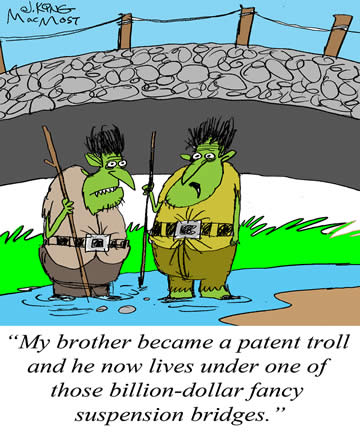
I am quoted extensively in this week’s Massachusetts Lawyers Weekly in the article “Businesses increasingly assert patents for strategic reasons,” which discusses companies bringing patent infringement claims against their competitors as a business tactic, and whether recent Supreme Court decisions making it theoretically easier to obtain an award of attorney’s fees will reduce the number of such suits. It’s a well done article, particularly because it is not just based on the anecdotal evidence provided by lawyers, like me, but also on existing hard data that supports the thesis that such claims are on the rise. It is definitely worth a read if you have an interest in this phenomenon.
More on the Golf Course RFP
Susan Mangiero, one of my favorite experts on financial deals and transactions, was kind enough to post on my presentation to the Boston Regional Office of the Department of Labor, where I spoke on common mistakes by plan sponsors. I spoke as part of a day long training program that Susan presented at as well, even if she was too modest to mention it in her post, and I was very pleased and impressed by the audience, their participation and their questions. I have written before that I generally hold a high opinion of the Department’s staff, and the audience participation at the training session did nothing to lessen that opinion. Both in my primary talk, on plan sponsor mistakes, and during a subsequent panel that I participated in on litigation issues, fee disputes, and fiduciary governance of plans, the audience raised great points and asked pointed questions. One member of the audience shared with me an additional important mistake plan sponsors make, that I had not previously thought of as a significant problem, primarily because it is not one that arises in litigation but is instead more of a day to day compliance issue. There is nothing better as a speaker than having walked away having learned something from the audience that you did not know the day before.
Susan’s reference to the “Golf Course RFP,” which actually is a slide in my PowerPoint deck, concerns one of my chief cautions to smaller and mid-size companies, where benefit plans, particularly 401(k)/mutual fund programs, may be chosen by a company owner simply based on the vendors that are already in the owner’s social circle, such as, yes, those at his or her country club. If it turns out down the road that employees were paying too much for or getting too little from the plan, in comparison to what could have been located in the marketplace as a whole at that time, picking a plan’s vendor in that manner will most certainly come back to bite the company owner. Indeed, from a trial lawyer’s perspective, such a selection process would, in a fiduciary duty lawsuit over that plan, be a smoking gun used to show poor processes and a corresponding breach of a fiduciary duty. At the end of the day, RFPs aren’t normally conducted on a golf course, and this is one area of business life where it is especially important to remember that.
Why Commonality is Relatively Easy to Prove in ERISA Class Actions
One should never underestimate the fundamental role that procedural and related tactical issues play in a case, and how they impact the very question of whether a plaintiff will ever be able to have a judge or jury rule on the merits of a case. Procedural barriers to prosecuting particular claims can be the end of a case, without anyone ever hearing the merits of the dispute, unless a plaintiff can hurdle them. In a sense, this phenomenon means that a plaintiff often has to prove two parts, broadly speaking, of a case to win: first the procedural and tactical niceties needed to even get the case in front of a fact finder, and then the actual merits. In what is sort of a mirror image, a defendant can prevail in a case simply by winning either one of those parts of the case.
This phenomenon means that there are procedural opportunities for a defendant to prevail without ever proving the merits of the defendant’s case, but, interestingly enough, this does not exist in reverse: there really is no such thing as a procedural advantage that might allow a plaintiff to prevail without ever proving the merits of the case (other than an outright default by a defendant, but that really doesn’t happen unless the defendant is judgment proof which, for a plaintiff, is the same thing as losing).
Nowhere is this phenomenon clearer than in class action litigation, in which lawyers and courts have taken to focusing on the procedural requirements for forming a class, in ways that to some extent tend to devalue, by comparison, the merits (or lack thereof, as the case may be) of what the putative class representatives and the class itself may have to say. This approach to class action litigation essentially gives pride of place to the propriety of forming a class, over the merits of the case. If the plaintiffs cannot get past this procedural hurdle, they will never get the merits of their case heard; simultaneously, if defendants can ensure that plaintiffs don’t get past that hurdle, then they effectively win without anyone ever getting to the merits of the claims.
Commonality – which is the requirement that the class members have some central part of their claims against the defendant in common – is the central focus of this aspect of class action litigation, but it has a less than great track record in precluding certification of classes in ERISA cases. There is a clear and interesting reason for this, but it is best approached by the back door, by first explaining how defendants faced with ERISA class actions attack commonality, and seek to use the requirement of commonality to preclude certification of a class and thereby end class action litigation before the merits of the action are reached.
As explained in this excellent blog post, there are a number of ways to attack commonality in an ERISA class action, by focusing on what may be different among the members of the proposed class. I like the article a great deal as a handy checklist for where to start with regard to investigating and challenging the existence of commonality – and by extension the propriety of forming a class – in ERISA litigation.
However, in the ERISA context, one should not be fooled into overconfidence by these types of lists or, as well, by the fact that this procedural tactic has been very effective in various types of class action cases. Commonality is simply not that difficult to prove in ERISA litigation, in comparison to other types of proposed class actions, such as wage cases. This is because, in general, breaches of fiduciary duty related to an ERISA plan affect all participants and beneficiaries in the same manner, which renders the ERISA violation at issue common to all members of a proposed class. The only real trick in this regard is for the plaintiffs to make sure they account for any aspects of the breach in question that might render only some participants (for instance, those in the plan during a certain time period) and not others subject to the violation, and to then draw appropriate lines around the makeup of the class so as to laser out any plan participants who were not affected and harmed by the particular conduct in question. Do this, and commonality exists.
Clamping Down on Patent Litigation as a Business Tactic Among Competitors
In the years leading up to the Wall Street collapse of 2008, I spent a fair amount of my time defending smaller tech and similar companies against intellectual property suits, including patent suits and preliminary injunction proceedings, often involving infringement claims that were, in my book, specious at best. Interestingly to me at the time, these were not suits brought by what have since come to be known, quite pejoratively and perhaps sometimes accurately, as patent trolls. Instead, they were brought by larger and more well-funded competitors in the marketplace, in a clear tactical decision to try to drive out smaller rivals by pursuing questionable claims of infringement. These were really just suits brought as business tactics, as the parties moved from competing in the marketplace to competing in the courtroom as well, a phenomenon I once summed up in the phrase “much as war is the continuation of politics by other means, patent litigation is the continuation of a business dispute by other means.” Interestingly, this dropped off substantially, at least among smaller companies, once the Great Recession hit, as companies became a lot more concerned with staying in business than with spending funds to sue competitors as a business tactic.
It’s interesting to note, though, that this has clearly picked up again over the past few years, even among smaller companies and separate from the similar attempts to gain business advantage in the courtroom pursued by large companies, such as Apple and Samsung, who are not so sensitive to the boom/bust cycle in pursuing such tactics. Given that the last time I saw this, the stock market dropped a gazillion points not long afterwards, one might want to ask whether this uptick is a sign of yet another stock market bubble.
But no matter, as that is a topic for another day, and events themselves will establish it one way or the other. Of more interest to me, and the reason I write today, is that, while everyone else is focused on the impact on patent trolls of the Supreme Court’s recent decision in Octane Fitness, LLC v. ICON Health and Fitness, Inc., which makes it easier for a wrongfully accused defendant in a patent action to recover fees from a plaintiff, I am more interested in whether this same new decision will make it a little less likely that a wealthier company with a questionable patent will take to the courts to try to shut down a comparatively less wealthy competitor or, if not shut them down, to at least bog them down in litigation they cannot afford except by shortchanging their business operations. That alone would be the most pro-business result I could imagine from a court known for issuing such decisions.
Under the patent act, attorney’s fees can be awarded in “exceptional cases,” and, as Porter Wright’s Melissa Barnett explained, the Supreme Court has now made it easier to satisfy that standard, holding that:
To me, with regard to the issue I raised above, the question is whether courts will become more willing to grant attorney’s fees on a regular basis in circumstances where the plaintiff is not a patent troll, but instead a competitor who is pressing a questionable claim simply or predominately as a business tactic. If so, that risk would have to be factored into the cost benefit analysis of any company considering such a strategy, even one that is in the business of manufacturing or selling the product in question and is not a patent troll, and might well lead to less filing of infringement suits of the “patent infringement claim as business tactic” kind.
However, I am concerned that federal trial courts may well read the Supreme Court decision, given the environment in which it was issued – where all the focus is on trolling – as simply license to whack trolls, when a court views a patent infringement suit as nothing more than trolling for licensing fees. Time will tell as to whether it will also be used to reign in the type of cases I am describing here, but I was encouraged in this regard by something that Barnett wrote in her excellent blog post on the Supreme Court decision setting the new standard for awarding attorneys’ fees. She noted the existence in the case of “an email exchange between ICON executives that the suit was brought as a ‘matter of commercial strategy’ ” and, in fact, when you read the Supreme Court opinion, there is substantial documentation to this effect. The impact of this type of evidence on the question of whether to award fees in a case where a competitor uses patent infringement litigation as a business tactic is not fully developed in the Supreme Court opinion, but the reference in the decision to this type of evidence certainly opens the door for much more substantial consideration of this issue by lower courts in future cases.
As one who thinks that the proper place for business competitors to prove the worth of their products is – other than in the case of significant evidence of infringement – the marketplace, not the courtroom, I hope that turns out to be the case.
What if Trust Law Cannot Support the Moench Presumption?
The “stock drop” presumption of Moench, now before the Supreme Court in Fifth Third Bancorp, is best understood as a judicial attempt to balance the sometimes conflicting demands placed on corporate insiders by, on the one hand, the securities laws and, on the other, ERISA, when it comes to employee stock plans in publicly traded companies. It’s not an unreasonable tack to take, even if those perceived conflicts could be easily handled and avoided simply by the use of an outside independent fiduciary, as W.R. Grace did years ago in the situation that became the First Circuit case of Bunch v. W.R. Grace, which I discussed here, rather than using a corporate insider in that role.
The problem though, for those who believe that it is appropriate for the courts to find a way to balance those obligations, is how to get to that result. The terms of the ERISA statute itself don’t easily lend themselves to the creation, justification and imposition of the presumption, leaving the importation of, and reliance upon, doctrines developed under trust law to provide a basis for the creation of the presumption. But what if trust law, properly understood, cannot support the creation of a presumption of that much benefit to plan fiduciaries? Can the presumption stand if that is the case? The extent, nature and degree to which the Supreme Court grapples with these two issues – whether either the terms of the statute or the scope of trust law can support the presumption – will tell a very interesting tale, by illustrating whether the presumption’s status is actually driven by the legal foundation crafted by the statute and trust law or, instead, by an outcome driven need to balance the securities law regime with the dictates of ERISA. If the presumption is found valid, one will need to look closely at whether the Court was able to properly base that conclusion in the historical intricacies of trust law or in the statute’s language. If so, then the presumption can be understood to follow naturally from existing law; if not, then the presumption must be seen, as many have argued it is, as simply a convenient judicial fiction, one not properly founded on either trust law or statutory language, used to balance conflicting legal obligations imposed by distinct statutes.
Into this question rides Professor Peter Weidenbeck, in this absolutely fascinating article, “Trust Variation and ERISA’s ‘Presumption of Prudence’,” in which he details the history of the trust law basis on which the Moench presumption is said to rest, and finds that the trust doctrines relied upon by the courts that have created and applied the presumption do not support the presumption. In a nutshell, Weidenbeck argues "that prevailing state law standards governing trust variation do not impose the extremely restrictive (well-nigh insuperable) barriers that the federal courts following Moench mistakenly assume” and that deciding how to handle stock drop cases requires a more nuanced and comprehensive analysis of statutory history.
You can download his article here, and I highly recommend reading it. Even though it discusses tax issues and trust law, it is very readable, and only 24 pages in any event. At a minimum, the Supreme Court’s eventual opinion in Fifth Third Bancorp will make a lot more sense if you read the article first.
Fifth Third Bancorp and the Lack of a Historical Foundation for the Existence of a “Coach Class Trustee”
This is an interesting point, to me anyway, and a point that, for me, falls in that odd space between too short for a good blog post but too long for a tweet. I have written before that, because I seldom use blog posts to simply pass on others’ work and instead usually post substantive discussions, I created a twitter feed to have somewhere to pass along other people’s work when I am only going to briefly comment on it and not speak in depth on that work. This, of course, has left me in the position of not knowing exactly what to do when I have something to say about someone else’s writing that will take less than a couple of paragraphs to say but more than a hundred and forty characters. (Maybe someone needs to start a new micro-blogging app, say with 280 characters as the limit??).
Anyway, Chris Carosa has a wonderful essay out on the true and historic meaning of the term fiduciary, and the high level of care that its classic meaning imposes on someone serving in that role. The timing of the essay is interesting, coming as it does right after the Supreme Court heard argument on the Fifth Third Bancorp case, concerning whether there are limits on the fiduciary obligations of the trustee of an ESOP that might not exist in other circumstances. As this argument recap by Timothy Simeone of SCOTUS blog points out, at least some of the Justices seemed troubled by the idea that the fiduciary in that circumstance might have a lesser standard of care than he or she would in other circumstances, with Justice Kennedy quipping that the ESOP fiduciary, if that is the case, would then be some sort of a “coach class trustee.” And therein lies the point I wanted to make, one too long to make in my earlier retweeting of Chris’ essay: it is impossible to reconcile the existence of a “coach class trustee” with Chris’ presentation of the historical meaning of the term fiduciary. You just can’t do it.
Can You Avoid Being Investigated by the Department of Labor?
I think pretty highly of the Department of Labor when it comes to ERISA governed plans, and feel they do a pretty good job across the board. That doesn’t mean, though, that you want to be investigated by them if you are a plan sponsor. It’s a little like being audited by the IRS – even if you didn’t do anything wrong and you don’t owe anything, it’s an experience you would rather avoid.
When it comes to 401(k) plans, there are a number of things that plan sponsors can do to avoid being the target of an investigation, and even more things they can do to make sure that, if they are investigated, the results are benign. I talk about them in detail in this article I am quoted in, “DOL Cracks Down on Employer 401(k) Issues,” on BenefitsPro.com.
Ayres is Wrong, and Hecker is Wrong: Establishing a Fiduciary Breach Through Excessive Fees
A further thought on Ayres’ focus on what he calls dominated funds, namely funds with higher than necessary fees that nonetheless contain a disproportionate amount of a 401k plan’s assets, and whether their inclusion by a plan sponsor should be seen as a fiduciary breach. As I discussed in a recent post, it’s a viable theory, and a welcome antidote to the very low bar set by the Seventh Circuit in Hecker on the question of fees when it found that simply including lots of funds with fees set by the market as a whole represented a sufficient effort by fiduciaries when it came to protecting participants against unnecessarily high fees. However, as I also pointed out in my recent post, the Eighth Circuit, in Tussey, cabined that mistake by the Seventh Circuit, without needing to take the broader step urged by Ayres, which is to treat the excessive use in a plan of one fund with higher fees, in and of itself and without anything more, as a breach (as Ayres and a co-author argue for here). It is probably a bit much to say that this later circumstance, without more (such as the circumstance being caused by a mapping strategy that benefits a plan sponsor by driving down operational costs), should be enough to impose liability for breach of a fiduciary duty.
And why is that? Probably because such an approach applies a very paternalistic view to 401k plans, employees, and their employers (in the guise of plan sponsor and/or plan fiduciary). Ayres’ thesis presumes the existence of low cost – presumably index – funds within a plan, along with higher cost funds, and assumes that it is effectively a breach to allow funds to flow into the latter. It seems to me, though, that it places too low a burden on participants, and gives them too little credit. If there are a range of funds available in a plan, and mapping or other decisions are not driving employee withholdings into the higher priced funds, then it seems to me participants should be free to make their own call on what funds to hold. Further, unless one accepts the premise that no knowledgeable investor would ever use any fund other than the lowest cost funds (which requires living under a presumption that only index funds or similar passive investing funds can ever be an appropriate investment), then it is not legitimate to say that a prudent person in the position of the plan fiduciary could not make available higher cost funds along with lower costs funds. If that is the case, then it cannot be a breach of fiduciary duty to include such a range of funds in a plan – even if it results in some participants over investing in the higher cost funds.
In essence, while the Seventh Circuit – as I have often said and written – was wrong to believe that the inclusion of many funds is enough to preclude a breach of fiduciary duty by the inclusion of investment options with excessive fees, so too is the premise that simply having an excessive amount of assets invested in a higher price product that is included among many funds with varying fee structures is enough to constitute a breach. The truth, as with most things, lies somewhere in between – you need more than simply excessive investing in a higher priced fund, and less than simply inclusion of many fund choices, to have a fiduciary breach based on the costs of the investment options in a 401k plan.
Tussey v. ABB – Opening Up New Avenues for Excessive Fee Litigation and Putting the Final Nail in the Coffin of Hecker v. Deere
This Forbes opinion piece by Yale Professor Ian Ayres is interesting for two things, one of broader relevance and one of interest perhaps to me alone. In it, he argues that our analysis of excessive fees as a potential fiduciary breach should not be based solely on fees in general, but also on an analysis of whether excessive amounts of plan assets are being placed into the one or two investment options in a plan that have particularly high fees, rather than in the many other investment options in a plan that have lower fees; those lower fee options give a plan the image of having reasonable fees, by balancing out the fees charged in the more expensive options. He suggests that Tussey v. ABB should be thought of and analyzed as a case concerning this type of a fiduciary breach, where the problem with the fiduciary’s conduct was the decision to map plan assets into higher fee funds for the benefit, in the longer run, of the plan sponsor. This broader argument for rethinking how we analyze fiduciary prudence in the context of fees opens up new avenues for prosecuting fee claims, but also raises a red flag that prudent and conscientious plan sponsors need to pay attention to; namely, is the overall structure of plan choices optimal for the participants, rather than just whether there are some low cost choices open to the participants who are sophisticated enough to want to avoid the higher cost options. In essence, it is an argument that plan sponsors who want to do a good job for their participants need to see the forest, not just the trees, in structuring a plan.
And this is important because, jaded and cynical as I may be after litigating ERISA disputes for decades, I still think most plan sponsors are truly motivated to put together a strong plan for their employees, and are not motivated – at least not knowingly and consciously – by nefarious purposes. (Before people start bombarding me with emails and comments about their own experiences or particular cases they have been involved with that are to the opposite, note that I said “most,” not “all,” and that I made the word choice deliberately). Diligent plan sponsors who want to create the best possible plan would do well to keep Professor Ayres’ thesis in mind in formulating a plan structure and selecting its investment options.
I also said that the article was interesting to me, as well, on another level, one that may be of interest only to me. A few years back, right after the Seventh Circuit had decided Hecker v. Deere, I took the decision to task in an article,”Retreat from the High Water Mark: Breach of Fiduciary Duty Claims Involving Excessive Fees after Tibble v. Edison International.” In it, I argued that the Court was wrong to believe that having a range of fee options spread among many investment options was enough to defeat an excessive fee claim. Ayres likewise takes exception to the Seventh Circuit’s analysis in this regard, finding that it was not consistent with plan reality. To me, one of the most important parts of the holding in Tussey v ABB was not the float issue, heavily focused on by most reports, but the Eighth Circuit’s ringing rejection of the thesis, pressed by the Seventh Circuit in Hecker, that it was enough to defeat an excessive fee claim that a plan provided a range of investment options with a range of fees; the Eighth Circuit, in my thinking, put a well-deserved end to that line of argument, when the Court explained:
The ABB fiduciaries contend the fact the Plan offered a wide “range of investment options from which participants could select low-priced funds bars the claim of unreasonable recordkeeping fees.” In support, the ABB fiduciaries rely on Hecker v. Deere & Co. (Hecker I ), 556 F.3d 575, 586 (7th Cir.2009), Loomis v. Exelon Corp., 658 F.3d 667 (7th Cir.2011), and Renfro v. Unisys Corp., 671 F.3d 314, 327 (3d Cir.2011), which the ABB fiduciaries propose “collectively hold that plan fiduciaries cannot be liable for excessive fees where, as here, participants in a self-directed 401(k) retirement savings plan that offers many different investment options with a broad array of fees can direct their contributions across different cost options as they see fit.” The ABB fiduciaries’ reliance on Hecker I and its progeny is misplaced. Such cases are inevitably fact intensive, and the courts in the cited cases carefully limited their decisions to the facts presented.
I have always thought that Hecker was wrongly decided with regard to this issue, and that one of the reasons for the mistake was that the Court did not fully develop and analyze the factual context before reaching a decision. As a result, I don’t necessarily agree with the Eighth Circuit that Hecker is limited to its own circumstances by its own facts; I think it is limited to its own circumstances by its poor reasoning in this regard. Nonetheless, I can live with the Eighth Circuit approach, which I think all other courts are likely to follow as well, that Hecker’s erroneous analysis in this regard cannot control other cases because of the fact-intensive nature of the inquiry.
The First Circuit’s Wary Relationship to the Moench Presumption
By the way, speaking of Fifth Third Bancorp, I take exception at the assertion (see here, for instance) that every circuit to consider the issue has effectively adopted the Moench presumption, although with some dispute over how and when to apply it. The First Circuit, which tends to favor fact specific resolutions of complex ERISA disputes over sweeping doctrinal approaches to resolving them, rejected a variation on the presumption in 2009 in Bunch v. W.R.Grace. The Court explained:
Appellants seek to induce us to reject State Street’s actions by having us apply a presumption of prudence which is afforded fiduciaries when they decide to retain an employer’s stock in falling markets, first articulated in Kuper v. Iovenko, 66 F.3d 1447, 1459 (6th Cir.1995) and Moench, 62 F.3d at 571–72. The presumption favoring retention in a “stock drop” case serves as a shield for a prudent fiduciary. If applied verbatim in a case such as our own, the purpose of the presumption is controverted and the standard transforms into a sword to be used against the prudent fiduciary. This presumption has not been so applied, and we decline to do so here, as it would effectively lead us to judge a fiduciary’s actions in hindsight. Although hindsight is 20/20, as we have already stated, that is not the lens by which we view a fiduciary’s actions under ERISA. DiFelice, 497 F.3d at 424; Roth, 16 F.3d at 917–18. Rather, given the situation which faced it, based on the facts then known, State Street made an assessment after appropriate and thorough investigation of Grace’s condition. Katsaros v. Cody, 744 F.2d 270, 279 (2d Cir.1984). This assessment led it to find that there was a real possibility that this stock could very well become of little value or even worthless to the Plan. It is this prudent assessment, and not a presumption of retention, applicable in another context entirely, which controls the disposition of this case. See also LaLonde v. Textron, Inc., 369 F.3d 1, 6–7 (1st Cir.2004) (expressing hesitance to apply a “hard-and-fast rule” in an ERISA fiduciary duty cases, and instead noting the importance of record development of the facts).
This came five years after the Court refused to accept and apply the Moench presumption in LaLonde v. Textron, where the Court explained:
As an initial matter, we share the parties’ concerns about the court’s distillation of the breach of fiduciary standard into the more specific decisional principle extracted from Moench, Kuper, and Wright and applied to plaintiffs’ pleading. Because the important and complex area of law implicated by plaintiffs’ claims is neither mature nor uniform, we believe that we would run a very high risk of error were we to lay down a hard-and-fast rule (or to endorse the district court’s rule) based only on the statute’s text and history, the sparse pleadings, and the few and discordant judicial decisions discussing the issue we face. Under the circumstances, further record development—and particularly input from those with expertise in the arcane area of the law where ERISA’s ESOP provisions intersect with its fiduciary duty requirements—seems to us essential to a reasoned elaboration of that which constitutes a breach of fiduciary duty in this context.
At the end of the day, once the Supreme Court has ruled in Fifth Third Bancorp, these decisions may be rendered little more than a historical oddity and an interesting backdrop to the development of the presumption of prudence in the case law. For now, though, they constitute an interesting footnote to the discussion about how the various circuits have, to date, applied the Moench presumption.